Could 2021 Be The Breakout Year For Cannabis-Infused Food And Beverages?

Could 2021 Be The Breakout Year For Cannabis-Infused Food And Beverages?

Although the pandemic slowed progress, the outlook is brighter as more companies enter the market and the regulatory environment has the potential to change.

There were big expectations for the cannabis-infused food and beverage space leading up to the start of last year. Venture capital investment was increasing, seasoned executives were jumping into the trendy space and established players pledged to launch products

But 2020 was not the breakout year for cannabis that some had anticipated. 

Although the industry made progress, the pandemic slowed down product development as many companies shifted focus to the coronavirus. Federal regulation also stayed in a gray area, with no further guidance and many questions around the space unanswered. 

But now analysts and companies are saying that 2021 could in fact be cannabis’ breakout year. More states legalized cannabis in the last election cycle and a new presidential administration is coming in with a Democratic-controlled Congress that could push the FDA to issue a federal regulatory framework. 

“We’re seeing legalization spread to markets that were a challenge for cannabis activists in the past … so I expect that to continue in the coming year,” said Alex Esposito, research analyst at Euromonitor International. “As more recreational markets come online, we generally expect there to be more availability of edible and beverage formats.”

With potential regulatory changes on the horizon, more companies are moving into the U.S. market with products that have CBD, the popular nonpsychoactive compound of the cannabis and hemp plants, and THC, the most well known psychoactive component. Several companies from Canada are entering the U.S. market through acquisitions and readying launch plans that could shake up the category — and push more big-name players to jump in. 

“The U.S. is expected to be the largest market opportunity globally and we will be ready and well positioned to compete in the U.S. when cannabis is federally permissible,” said Irwin Simon, chairman of the board and CEO of Aphria, a Canadian cannabis company that is entering the U.S. market through a recent brewery acquisition. 

How Regulation and Elections Are Shaping Up

There are a lot of moving pieces in the regulatory space when it comes to cannabis and CBD, from state legalization and legislation to FDA regulation. But analysts say those moving parts are taking small, positive steps for the industry. 

The passage of the 2018 Farm Bill, which allowed hemp and its derivatives to no longer be classified as controlled substances, was a significant move for CBD, which can be sourced from this relative of the cannabis plant. However, it is still federally illegal to add cannabis and its derivatives to food and drink. It’s been nearly two years since the FDA’s first public hearing on CBD, where manufacturers pushed for more clarity.

Although more states have developed their own regulations and voted to legalize cannabis, which has allowed more companies to market-test products, the FDA has continued to issue warning letters to businesses that are improperly advertising CBD with therapeutic and drug-like claims

“I hope that this is finally the year that the FDA creates some guidance,” said Henry Baskerville of Fortis Law Partners. “In a way it’s really harming the industry to have no guardrails because for a lot of reasons it makes it so that consumers are maybe more reluctant to try the products than they otherwise would if they were at least passively accepted by the FDA.”

Jeremy Kahn, a spokesperson for FDA, said in an email that they are “working toward a goal of providing additional guidance, and have made substantial progress.” Kahn said the FDA is looking into potential pathways for various types of CBD products to be lawfully marketed and is working to get research, data and other safety input to inform its approach.

“The FDA recognizes that there is substantial public interest in marketing and accessing CBD for a variety of products,” Kahn said. “There are many questions to explore regarding the science, safety, effectiveness and quality of products containing CBD, and we need to do our due diligence.”

​One positive development happened in December, when the House of Representatives passed the Marijuana Opportunity Reinvestment and Expungement Act. The bill sought to decriminalize marijuana nationally by removing it from the government’s Schedule I controlled substance list. With a new Congress, it would need to be reintroduced, pass again in the House and will still likely have challenges in the Senate. The FDA would still determine regulation for cannabis’ inclusion in food and drink. 

At a recent BevNet forum, Rick Maturo, associate director of client services at Nielsen’s cannabis practice, described the vote as “very ceremonial more than anything.” That said, “it really just shows yet again that cannabis does not carry the stigma that it carried five years ago, and that’s going to continue to barrel forward and garner more attention from conventional consumer packaged goods companies,” he said. 

Mike Gruber, vice president of regulatory and government affairs at the Consumer Brands Association, agreed that the marketplace needs stability. CBA has been advocating for additional resources, research and a national regulatory framework around CBD for the last few years. 

“I think there’s a pivot point here for 2021 for all stakeholders to get behind legislation that provides FDA additional authority and additional funding to create a durable, national standard for CBD and other hemp derivatives that may be used in food, beverages, topicals and other products,” Gruber said. 

That pivot point could be closer to reality given the shift in politics at the executive and legislative branches. With President-elect Joe Biden headed to the White House and Democrats taking control of Congress, optimism around this issue is up. When Georgia turned blue this month in a run-off election, hopes of federal decriminalization helped push up cannabis stocks like Canopy Growth

“What we saw from the recent presidential election was positive momentum for the cannabis industry. We believe that Biden’s win will increase pressure on Congress to pass major federal marijuana reform in the near future,” said Tara Rozalowsky, vice president of beverages and edibles at Canopy Growth.


“I think there’s a pivot point here for 2021 for all stakeholders to get behind legislation that provides FDA additional authority and additional funding to create a durable, national standard for CBD and other hemp derivatives that may be used in food, beverages, topicals and other products.”

Mike Gruber

Vice president of regulatory and government affairs, Consumer Brands Association

A spokesperson for Biden directed Food Dive to his previously posted position: He wants to decriminalize cannabis use and supports the legalization for medical purposes, while leaving decisions regarding legalization for recreational use up to the states. Biden also supports rescheduling cannabis as a Schedule II drug so researchers can study it.

Baskerville said that although Biden has been “lukewarm, to put it lightly, about legalization,” the Democratic Party in general is in favor of it. “I think the writing is on the wall that it’s one of the few issues that has broad bipartisan support, and I think that it’s only a matter of time until cannabis is descheduled,” Baskerville said. 

In 2021, recreational use will be legal in 15 states and medical use will be legal in 35 states. Despite the patchwork of state regulations for cannabis, “it’s only a matter of time before it gets federally legalized,” said Tyler Williams, chief technical officer and founder at Cannabis Safety & Quality.

Williams expects FDA to be looking at state regulations and those in other countries, such as Canada. “If I was putting myself in the shoes of the FDA, I would look at regulations across the board, and pick and choose from the best ones, pick and choose what works and what doesn’t work. Then obviously base everything off of science because the industry has had enough of arbitrary numbers,” he said.

The Waiting Game On When To Jump Into The Market

The pandemic has also bogged down some of the regulatory process and product introductions. As consumers cleared shelves in their rush to stockpile food, many companies focused on maintaining production of their existing products instead of developing new ones. 

Bolthouse Farms, a maker of smoothies and juices, previously said it would launch CBD-infused products in 2020. More than a year has passed since the announcement, and a spokesperson said in an email the company is “still working through the regulatory environment in order to introduce any CBD products.”

“Unfortunately, COVID has essentially stalled all state and federal momentum on the topic so there hasn’t been much movement on that front,” the spokesperson said, declining to provide a timeline on the new product line launch. 

In 2019, Unilever’s Ben & Jerry’s brand said it would create CBD-infused frozen treats once there are regulations in place from the FDA. Ben & Jerry’s spokesman Sean Greenwood said in an email the company remains on hold on any new CBD product development, but to “stay tuned in 2021 for any updates.”

“COVID operations have posed a challenge as we’re not able to work at our office and we’re making it a go remotely to ensure safety of our employees. We’re still interested in CBD products as it’s something that our fans expressed interest in,” Greenwood said. 

Investors have also been wary of the space because there is some regulatory risk involved, and brands need to be careful to follow any state guidelines for advertising, transporting and manufacturing products. 

There has been some momentum in the past year, with brands securing an early-mover advantage by launching in states that have legal markets while awaiting more federal guidance.

Late last year, Pabst Labs announced the initial launch of Pabst Blue Ribbon Cannabis Infused Seltzer to customers in California. Although PBR is licensing its name to the brand, no money was involved in the agreement and Pabst Brewing doesn’t have a stake in Pabst Labs, which helps it avoid any regulatory risk associated with the substance.

Mark Faicol, the brand manager of Pabst Labs, said that its seltzer, which contains 5 mg of THC per 12-ounce can, was in development for about two years before it became “worthy” of the PBR name. 

“A national brand heading into the space has never been done before. Let’s not underscore the significance of that,” Faicol said. “I think a lot of big brands … bring their audience that they know how to talk to really well. And No. 2, they bring a level of trust.”

Faicol, who previously worked for Pabst Brewing Co., said PBR is a classic brand, but is constantly reimagining itself as “more than just a beer company.” Faicol said there was already demand for a cannabis-infused drink with PBR’s name on it before they developed it.

Pabst Labs has already seen success with the product and is planning to expand production this year. It sold out of its initial two production runs immediately, according to Faicol, who said the company plans to expand to selling in other states. Having a brand name that “transcends generations” carries weight, Faicol said, but there are still challenges with regulation and broader consumer education.  

“We have very high expectations, but I think at the same time we fully realize … that it’s going to be an uphill battle and challenge. But we’re willing to take that challenge on and work with other key players in the space to try and grow it,” Faicol said.

Many smaller brands have launched in states that have legalized. Recess, for example, has quickly become one of the most popular CBD beverage brands in the country. 

Recess’ CEO and Founder Ben Witte said the company focused on establishing the base of its business in 2020, growing in key markets, building out the supply chain and investing in innovation that will launch this year. 

Witte said the company spent the last year getting positioned for 2021, “which will be a big breakout year for us.”

“I definitely think part of the business plan for Recess was to become really the category-defining and first-mover brand in this emerging category,” Witte said. 

The company has learned a lot about the usage occasion for Recess during the past year. Previously, consumers may have gotten drinks at a local bar after work, Witte said. But during the pandemic, many people are using Recess as a substitute for alcohol in the evening.

“Do you really want to drink at home by yourself at the end of the day? Take a Recess instead, and that idea is just exploding in popularity,” Witte said. “We are well positioned to continue to drive [the market] forward but we welcome more entrants. We want this category to exist in a big way.”

Part of what will enable this potential is federal regulations around cannabis-infused products. Witte said Recess’ business plan from the beginning was oriented around regulation since he didn’t want to sell a controlled substance indefinitely. But he sees “a light at the end of the tunnel.”

The exec, who also serves as executive vice president of the U.S. Hemp Roundtable, said this year the attention will be focused on driving FDA clarity, and he expects something to come from the agency in the next 12 months.

Big Moves Bring Canada’s Momentum To The U.S.

Over the last year, Canada — which now allows cannabis-infused products to be sold at retail — has served as a testing ground for the U.S. debut. Canadian companies are now entering the U.S. this year as many of their American counterparts wait on the sidelines. 

Canadian cannabis giant Aphria announced late last year it was expanding into the U.S. with its $300 million acquisition of SweetWater Brewing Co., one of the biggest independent craft brewers in the U.S. Aphria has several medical and recreational-use cannabis brands in Canada. 

“The beer and cannabis industry have been tied closely in recent years as both industries are ripe for a cross-over audience. We will continue to see mergers and acquisitions when it comes to cannabis companies purchasing beer brands and vice versa,” said CEO Simon. “It’s only a matter of time before the U.S. moves closer towards federal legalization of cannabis and building out infrastructure in advance will continue to be a top priority.”

Simon said that Aphria sees “a huge market for CBD and THC beverages in the future.” Since SweetWater has distribution across 27 states and Washington, D.C., it provides a “recognizable foothold in the U.S. with long-term potential.” With the acquisition, SweetWater will grow beyond those states and internationally, Simon said. The Aphria team is also preparing to introduce its Broken Coast, Good Supply, Riff and Solei brands to the U.S. by this winter.

Aphria also grew its foothold in the consumer packaged goods space with its recent merger with Tilray, a Canadian pharmaceutical and cannabis company that owns Manitoba Harvest, the world’s largest hemp foods manufacturer, and is a partner of AB InBev.

But Aphria is not the only Canadian company looking to take the early-mover advantage across North America. Last week, Truss CBD USA, a joint venture majority owned by Molson Coors Beverage Co. and operated with Canadian cannabis producer Hexo, launched Veryvell, a line of nonalcoholic sparkling CBD beverages in Colorado.

Canopy Growth will also be launching cannabis-infused beverages in legal-use markets in California and Illinois this summer through its partnership with Acreage Holdings. After a delayed launch in Canada, Canopy Growth, which is backed by U.S. alcohol giant Constellation Brands, has seen “great success to date” for its cannabis-infused beverages in Canada, and currently holds about 50% market share, Rozalowsky said.

“With almost a year’s worth of sales data available for the Canadian market, paired with Constellation’s experience in the beverage alcohol space, we know that summer is an ideal time to launch a beverage brand or product in order to capture consumer demand spikes during key summer months,” Rozalowsky said.

The cannabis-infused beverage category is fragmented, she noted, with numerous brands in the U.S. but no clear leader. This gives Canopy the opportunity to capture significant market share, she added.  

Euromonitor forecasts the market for adult-use cannabis, including in beverages and edibles, in the U.S. will grow from about $11.5 billion in 2020 to $53.6 billion in 2025. 

“From what we’ve seen so far in terms of consumer demand, we believe that the North American market potential for cannabis-infused beverages is extremely promising and has the potential to disrupt other traditional beverage formats including beverage alcohol, sports and energy drinks and sparkling waters,” Rozalowsky said.
Originally Posted: FOODDIVE

Industry Weighs In On DEA Cannabis Research Final Rule

Industry Weighs In On DEA Cannabis Research Final Rule

The Drug Enforcement Administration (DEA) has released a final rule that addresses forthcoming regulations regarding federally legal cannabis research.

The announcement of the final rule follows the United Nations Commission for Narcotic Drugs’ vote to remove cannabis from its list of most dangerous drugs, and the U.S. House and Senate’s passage of cannabis research bills.

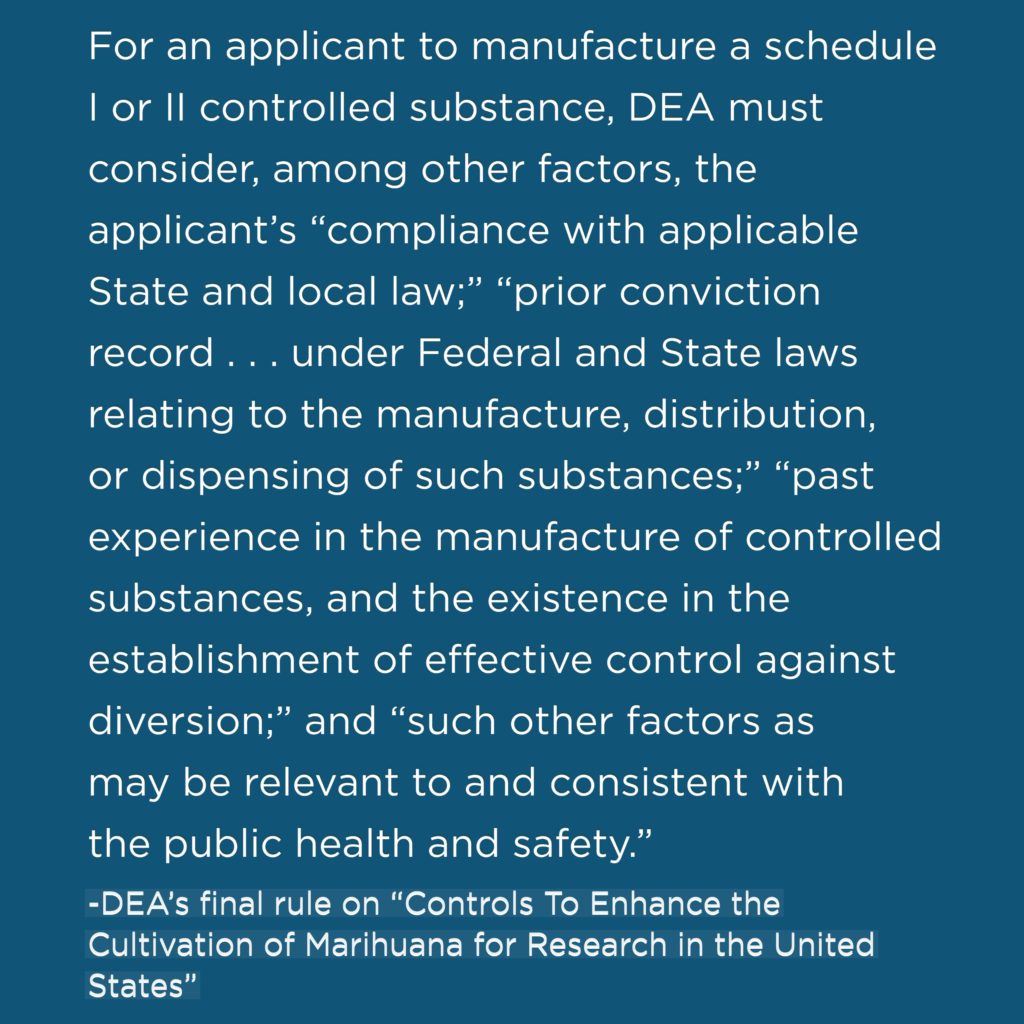
In the public comment section of the rule, which goes into effect Jan. 19, 2021, DEA explains that “past experience in the manufacture of controlled substances” will be a factor the agency will consider when reviewing applications. The rule, citing the U.S. Congress, states: 

The rule continues: “…An applicant that has manufactured marijuana without obtaining a DEA registration has violated Federal law, … regardless of whether that manufacturer has violated the laws of the State in which the applicant is located. … While the DEA Administrator has discretion to weigh the statutory factors and any one factor need not be dispositive, an applicant’s prior compliance with Federal law is a relevant consideration when determining whether to grant an application for registration.”

Some see DEA’s registration criteria as a red flag. Henry Baskerville, a partner at Fortis Law Partners provided the following statement to Cannabis Business Times and Cannabis Dispensary.

“The federal cannabis cultivation license allows companies to grow cannabis for use in clinical research. Excluding those who currently have state cultivation licenses is excluding people and companies that have the experience effectively cultivating cannabis. This makes no sense from a clinical perspective and is simply punitive action by the DEA against persons and businesses who have been participating in legal activity under state law.”

Tyler Williams, founder and chief technical officer at Cannabis Safety & Quality, said DEA’s final rule may be in part an act of self-preservation.

“I think that with the MORE [Marijuana Opportunity Reinvestment and Expungement] Act gaining traction and federal legalization around the corner, the DEA is kind of stuck in a corner,” Williams told CBT and CD. “… And when you back an agency in a corner after you’ve taken out a majority of the product that they control, which is cannabis—once you legalize it federally, they no longer have control over it.

“That means a large portion of their budget goes away in theory, or it should. So, you have this agency that is kind of clawing their way back and trying to gain control, so I think, in my personal opinion, that this is a way for them to say, ‘Ok, well, if we go the route of descheduling cannabis, we can do it our way and still have control over it.’ And that’s exactly what it sounds like they’re trying to do.”

However, some companies are moving forward in the application process. In 2019, DEA selected MedPharm Research as an applicant to obtain a research license. MedPharm Holdings CEO Albert Gutierrez said in an email to CBT and CD that MedPharm Research operates separately from MedPharm’s commercial manufacturing operations, which produce AliviarBatch and Become products. As MedPharm Research does not produce commercial cannabis products, Gutierrez said it follows all federal laws.

“There are always obstacles in new industries and areas of opportunity, but we remain confident in our capabilities, know-how, and relationships with various universities to carry out a great program that will help shed light on the medicinal value of cannabis,” Gutierrez said. “We welcome the opportunity to collaborate with the DEA and others on this venture and look forward to what is to come.”

Regarding the final rule language addressing criminal convictions, industry stakeholders have shared, in reference to the Marijuana Opportunity Reinvestment and Expungement (MORE) Act, that when federal officials make past criminal convictions a factor in whether to allow industry participation, it reduces social equity.

Dasheeda Dawson, cannabis program supervisor for the city of Portland, Ore., told CBT and CD contributor Raj Chander via email: “Over the past few years, the definition of cannabis equity has centered on providing opportunities to those most adversely harmed. Undoubtedly this starts with those who were previously arrested or incarcerated for cannabis.”

The public comment section of the final rule also addressed cannabis product quality. “Some commenters stated that the current quality of marihuana produced for Federal research is of poor quality,” DEA stated, referring to cannabis produced at the University of Mississippi.

In response, the agency wrote: “The purpose of this rule is to increase the number and variety of marihuana growers in order to diversify the supply available to researchers. As proposed in the NPRM and finalized in this rule, one of the selection criteria for marijuana grower applicants is the “applicant’s ability to consistently produce and supply cannabis of a high quality and defined chemical composition.”

The agency also noted that someone commented that DEA should extend “the time period for providing notice of a harvest to five days beforehand, instead of 15 days beforehand,” as DEA had previously indicated was its plan. The agency’s response stated that “DEA has concluded that a five-day notice period will not provide sufficient time to make the arrangements needed to travel to a grower and attend a harvest.”

The final rule is published in the Federal Register.

Originally Posted: Cannabis Business Times

What Could The DEA’s Interim Final Rule Mean For The Hemp Industry?

What Could The DEA’s Interim Final Rule Mean For The Hemp Industry?

DEA accepted public comment on the proposed regulations through Oct. 20, 2020.

Earlier this year, the Drug Enforcement Administration (DEA) released an interim final rule that the agency says will bring the Controlled Substance Act in line with the 2018 Farm Bill, which opened the door for the production of hemp.

The proposed final rule classifies any Cannabis sativa L. material with Delta-9-THC content greater than 0.3 percent on a dry weight basis as “marihuana,” a schedule I controlled substance. Hemp is classified as Cannabis sativa L. with Delta-9-THC content of 0.3 percent or less.

As part of this proposed guidance, a cannabis derivative, extract or product that exceeds the 0.3 percent Delta-9-THC limit is controlled, even if the plant from which it was derived contained 0.3 percent or less Delta-9-THC on a dry weight basis. This presents a challenge for extractors, since THC content may exceed the limit before or during the extraction process.

The DEA accepted public comment on the interim final rule through Oct. 20, and more than 3,300 electronic comments were submitted. The agency has not made any additional movement these proposed regulations.

While the industry awaits further guidance, Tyler Williams, founder and chief technical officer, Cannabis Safety & Quality, and Harvey Craig, founder and CEO of Harvey’s All Naturals, weighed in on what the DEA’s interim final rule could mean for both extractors and manufacturers of infused products.

CP: Why would the DEA consider regulating THC content during the extraction stage, versus just the hemp plant or finished products? Does the DEA have jurisdiction over this?

TW: The industry’s main concern is from the following statement: “Note that CBD in a mixture with a Δ9-THC concentration greater than 0.3% by dry weight is not exempted from the definition of ‘marihuana’ or ‘tetrahydrocannabinols.’ Accordingly, all such mixtures exceeding the 0.3% limit remain controlled substances under schedule I.”

This change would mean that any hemp-derived CBD raw materials or work-in-progress (WIP) that is over the 0.3 percent limit would technically be illegal and it would be a controlled substance under schedule I. This is very typical to see in the industry. For example, as an extraction facility you will likely receive biomass over the 0.3 percent limit. However, through different processing techniques and formulations the finished product can be under the 0.3 percent limit. 

I think the DEA is just trying to do everything they can to strong-arm their way into maintaining control over cannabis. As a government agency, the DEA’s goal is to not lose funding. Once the DEA starts losing control over cannabis, then departments within the agency start shutting down and people lose their jobs. The DEA has publicly stated that the regulations within the 2018 Farm Bill were always meant to be this way, and this IFR was their way of providing “clarification” that inevitably confused the industry more than anything. It’s really about keeping their hands in the pot, so to speak. The USDA has jurisdiction over the farming of hemp, and once the dry flower enters the processing phase, oversight is passed on to the FDA. 

CP: If this becomes the final rule, what could it mean for producers of hemp or CBD extracts?

TW: If this does become the final rule, then the DEA will need to prepare for multiple lawsuits, inevitably prolonging the waiting game for hemp and CBD companies still searching for helpful guidance. Beyond that, this means hemp and CBD manufacturers will be wasting thousands of dollars on destroying WIP that is above the 0.3 percent threshold. This is due to the DEA’s rules on destroying non-conforming product.

HC: For us, it basically means “business as usual.” As a farmer and producer, we are glad the FDA will further regulate hemp or CBD as a “food supplement” rather than a drug. My hope is that further regulations will weed out the scam products and help consumers by making producers truly show on the bottle what is in each product.

CP: If this becomes the final rule, what could it mean for producers of hemp- or CBD-infused food and beverages?

TW: For infusers (producers of CBD-infused food and beverages), this could mean the price of extract increases. This might be due to the amount of product that is wasted from the unnecessary destruction of raw materials and WIP that is over the 0.3 percent limit. 

The risk for infusers is a lot lower than the extractor in this situation. The infuser will purchase the extracted material from a supplier who will likely provide a COA stating it is below the 0.3 percent limit. However, the industry is still lacking standards for testing at this time. Let’s not forget the fact that two labs can come up with different results for the same material (e.g. one over, and one under the 0.3 percent limit). If I’m an infuser, my supplier approval procedure requires me to test my distillate and spot-check my supplier’s lab results. In those cases, which lab result would prevail if they showed different results? How can we have this strict of a limit if the industry still doesn’t agree on the best methods for testing? 

CP: Food and beverage products containing Delta-8-THC are popping up on the market. What could this rule mean for Delta-8 and synthetically derived THC? 

TW: The DEA has clearly stated the following: “All synthetically derived tetrahydrocannabinols remain schedule I controlled substances.” This means that any synthetically derived THC is a schedule I substance in the eyes of the DEA, even if it is below the 0.3 percent threshold. Delta-8 is still legal, if it meets the statutory definition of “hemp,” which is limited to materials derived from the plant Cannabis sativa L, and below the 0.3 percent threshold. 

However, if it at any time in the process surpasses the 0.3 percent THC limit, then it would be considered illegal and would need to be destroyed in accordance to the DEA. If this is enforced it would cost CBD producers/manufacturers a significant amount of cash and create yet another barrier to entering the market.

CP: Do you think this rule could have an impact on any guidance the FDA delivers on hemp and/or CBD in the future?

TW: Due to the profound lack of communication between these regulatory bodies, it’s tough to say. One can only hope that the FDA realizes the lunacy of these rules and aims to develop regulations based on sound science and cold-hard facts. The USDA has pushed back enforcement of certain interim rules, such as disposal of non-compliant plants and DEA laboratory registration. 

HC: From what I understand, there will be some new guidelines on what information is required via lab testing. Any legitimate oil producer should be able to provide this information rather simply. If they can’t, then they’re probably not providing a healthy/legitimate product to begin with. Therefore, the new federal regulations will hopefully make these companies either change or go out of business.

CP: What can hemp or CBD extractors or producers of hemp or CBD-infused food and beverages do to protect themselves in the meantime?

TW: As a hemp farmer or CBD manufacturer, the best thing you can do right now is to have all your ducks in a row, getting certified to standards that are based on science. In this industry, we walk a fine line of what’s legal and what’s not. And if you have all the paperwork showing that you’re trying to do the right thing, that’s going to go a long way. Not only does getting certified for safety and quality ensure a superior product to your customers, it also to creates a paper trail proving that you’re trying to play by the rules. 

HC: They can do their best to keep up with the new federal guidelines and follow protocol. It’s not easy as it sits right now to farm/process/produce cutting-edge products with many grey areas. Although, the Department of Agriculture here in Colorado has been helpful and understanding to work with as rules are implemented.

CP: Is there anything else you’d like to add?

TW: This misdirected guidance from the DEA is yet another reason to push for self-regulation. If the industry doesn’t self-police, it remains just another vice in the eyes of the skeptical public and opens up opportunities for organizations like the DEA to reignite fear and confusion within the industry. 

After the public comment period closes on Oct. 20, whatever their next move is, it’s going to be awhile before anything comes to fruition. The DEA will also have to release a statement, which will also be a waiting game. In the meantime, I would recommend looking into acquiring safety and quality certifications, which is where Cannabis Safety & Quality (CSQ) comes in handy. CSQ is a safety-driven company setting reliable cannabis industry standards to help companies minimize risk, protect their brand and provide the best product for their consumers. CSQ’s standards were built in 2020 to meet ISO requirements, Global Food Safety Initiative (GFSI) requirements and regulatory cannabis requirements from seed-to-sale.

HC: One big thing I have noticed in this saturated CBD gold rush is that most companies are simply making a product for profit by using low quality oils purchased on the wholesale market. I feel these companies are giving the industry a bad name. Hopefully, through proper regulation, the end customer will be able to understand the products and therefore make quality decisions in purchasing products that will truly help them with long-term benefits.

Colorado Marijuana Vape Aerosol Testing Rules Address Key Health Issues

Colorado Marijuana Vape Aerosol Testing Rules Address Key Health Issues

Marijuana Business Daily

By: Bart Schaneman

As they respond to the 2019 vaping health crisis, Colorado marijuana regulators are believed to be among the first in the nation to require cannabis vaporizer companies to test the aerosol produced when the oil is heated into vapor.

The new testing requirement, meant to make vaping safer for Colorado consumers, could prompt other states to follow suit, according to industry officials.

They also said the rules could create thousands of dollars in added costs for vaporizer companies and lengthen production lead times.

At the same time, however, the rules could reinforce consumer confidence in a sector that was stung by reports of the hospitalization of more than 2,500 people and the deaths of dozens from vaping-related lung illnesses.

The question of what happens to cannabis oil when vaporized came to the forefront during last year’s outbreak of vaping-related illnesses. The illnesses were eventually linked to additives in products secured from the illicit market.

The Colorado Marijuana Enforcement Division’s new heavy-metal testing rules is intended to help clear up that question.

Until now, only the oil has been analyzed in marijuana testing laboratories. Testing labs will likely have to add new equipment to conduct the aerosol tests.

Jesse Silver, senior vice president of product for San Francisco marijuana vaporizer company PAX Labs, sees this as an important step forward for the industry.

“Temperature, especially high, uncontrolled temperatures, produces byproducts when vaporized,” he said.

“So it’s common sense that rather than just testing the raw cannabis oil, we’d shift to testing the aerosol produced – the substance that is actually being inhaled by consumers – to ensure it doesn’t have harmful metals or other degradants in it.”

Another Colorado Marijuana Enforcement Division rule regarding shelf stability requires manufacturers to label cannabis vape cartridges with an expiration date. The new regulations don’t take effect until Jan. 1, 2022.

“The vape crisis a couple of summers ago really shed some light on how we can regulate vaporizers a little bit better,” said Kevin Gallagher, executive director of the Denver-based Colorado Cannabis Manufacturers Association (CCMA).

“It was weird that we were testing a formulation but not testing the final product.”

Business Impacts

Before the new vapor testing requirement, each test of a batch of product to be vaped cost about $500, according to Richard Batenburg, Jr., chair of Clear Colorado Group which makes The Clear, a brand of cannabis vaporizer and concentrate products.

The new rules add more challenges for cannabis companies by way of testing costs, possible testing failures and increased lead times.

Those factors could increase vape prices for consumers and perhaps speed up the closure of businesses that are already struggling with high costs, according to Batenburg.

“The impacts of these added regulations will hit both the wallet and the watch,” he added.

The current test includes potency, microbials, pesticides, heavy metals and solvents.

“Testing of the vapor will likely require entirely new testing equipment, which will result in the need for the testing facilities to charge a higher amount than that of the current tests,” Batenburg said.

“The direct cost of the testing will be the most obvious added cost for vape companies.”

Batenburg is also concerned about the added time it will take to test for vapor.

“Especially in the initial stages of implementation, as a vape company we will need to increase our on-hand inventory to account for the increase in production lead time,” he added.

“This could result in tens of thousands of dollars of additional on-hand inventory just to ensure we don’t run out of tested product.”

Alana Malone, CEO of Denver-based Green Dot Labs, agreed.

“Every new test requirement increases costs and operational burdens,” she said. “The more craft and small batch the company, the greater the cost increase as these tests affect each production batch.”

Depending on the size of the company and the approach to batch sizes, one additional testing requirement can increase product costs by up to 5% per test, Malone estimated.

“The premium, small-batch companies are hit hardest every time a new test is rolled out,” she said.

Industry Implications

Arnaud Dumas de Rauly, co-founder and CEO of New York-based vape manufacturer The Blinc Group, pointed out such standards for testing already exist in the non-cannabis vaping sector.

He added that while the main focus is on the cannabis oil in the vape cartridges, heavy metals can leach from the hardware, including the glass and heating coils.

That’s also why the shelf-stability testing component of the rules is important, as leaching of heavy metals happens over time.

“Ensuring customer safety is paramount to the longevity of the industry, and so long as regulations are geared towards that and not unnecessarily restrictive, then the industry should welcome it,” said Henry Baskerville, a Denver-based cannabis attorney with Fortis Law partners.

“Yes, it will cost more, but ensuring the safety of your product is worth the extra cost.”

Industry officials agreed the new regulations should result in a safer overall product for consumers.

“The strategy here is do something we know how to do and labs are equipped to be dealing with,” Dumas de Rauly said. “This is not meant to slow anything down.”

As for other states adopting similar rules, everyone interviewed for this story agreed that more will follow.

“I absolutely think it will happen elsewhere,” the CCMA’s Gallagher said. “We know that Colorado is a leader in cannabis policy, and we expect to see other states adopt a testing regime.”

Consumer Confidence

Ultimately, cannabis vape companies need to make sure their customers feel like the products are safe.

“Instilling customer confidence in the industry is paramount,” said Dana E. Shoched, president and CEO of Denver-based O2Vape.

“There are still a number of players that do not focus as much as we’d like on safety. It’s why those of us who do are so passionate about making sure there is a well-regulated and even playing field in each state.”

Like the food industry when there is a recall for lettuce, the whole cannabis industry sees a dip in sales after a recall, said Tyler Williams, founder and chief technical officer at Cannabis Safety and Quality, located in St. Louis.

“Even though a recall is tied with a specific brand, consumers associate all related products as unsafe. This is because consumers are worried about their health and safety, so they take extra precautions,” he added.

“Instilling consumer confidence will always be imperative.”

Batenburg noted that states with legal cannabis markets reported far fewer cases of vaping-related lung illnesses than states without licensed MJ businesses.

“While we fully support the ongoing efforts to ensure that the public stay healthy and safe while shopping at Colorado regulated dispensaries, we believe the data reflects what we have already done as an industry to keep our customers safe,” he added.

PAX Labs’ Silver echoed that, reiterating that the vaping health crisis was largely the result of products from the illicit market.

“We’ve seen the vape category bounce back over the past year as consumers have come to not only understand that reality but look to vape as an alternative to combustion during COVID,” he added.

“Consumers are savvy – we’ve seen a shift toward those products and brands that prioritize health, safety and transparency and expect this to continue.”

Originally Posted: Marijuana Business Daily

Muddied Waters

Muddied Waters

BOULDER WEEKLY

DEA releases proposed rules for hemp and CBD, reigniting fear and confusion within the industry.

By: Will Brendza

Hemp farmers everywhere sighed with relief when the Farm Bill was renewed in 2018. That renewal effectively decontrolled hemp, removing the plant from the definition of “marijuana” in the Controlled Substances Act and shifting the responsibility of enforcement from the Drug Enforcement Agency (DEA) to the U.S. Department of Agriculture (USDA). 

That’s a very important distinction, according to Henry Baskerville with Fortis Law Partners. The USDA is very pro-farmer; they want to work with farmers to help them succeed and produce as much as they can, he says. 

“The DEA, of course, is the opposite. They’re wanting to stamp out any sort of drug issues,” Baskerville says. “If you run afoul of the [USDA], they’re not raiding your farm with automatic rifles.”

The relief the 2018 Farm Bill offered was short-lived, however. In August of this year, the DEA released a slate of proposed rules for the hemp and CBD industry, which has once again stirred up nervousness and confusion among farmers and producers who don’t want to end up on the wrong side of the law. 

“Any time the DEA is trying to shoulder their way back into the party, for hemp farmers that’s a scary prospect,” says Baskerville, who works almost exclusively with cannabis, hemp and CBD clients. 

This Interim Final Rule (IFR), effective Aug. 21, aims to implement some of the Farm Bill’s hemp amendments into the Federal Controlled Substances Act (CSA). 

Some background: According to the 2018 Farm Bill, the difference between “hemp” and “marijuana” comes down to delta-9 THC content and that’s it. Legally speaking, hemp that exceeds .3% delta-9 THC becomes marijuana. Scientifically, though, both are part of the same family: cannabaceae; and even of the same genus: cannabis — no matter what their THC levels are. 

Meaning that hemp farmers have to walk a very fine line. They’re growing the exact same plant as pot farmers, but if their product exceeds that .3% delta-9 THC threshold, then they are suddenly running an illegal operation. 

Should that happen, under the 2018 Farm Bill, farmers or producers would have been dealing with the USDA. However, the DEA’s new IFR suggests that, in fact, hemp farmers aren’t yet out of the woods. If their flower or extract accidentally spikes over .3% delta-9 THC — at any point during the growing or extraction process — the responsibility of enforcement shifts back over to the DEA, and the farmer could be facing a massive fiscal loss as well as criminal charges. 

Which is a daunting prospect considering how much THC content can fluctuate with small environmental changes: simple sugars in the soil, temperature changes in a grow room and humidity can all cause THC levels in hemp plants to spike. And during CBD extraction, another cannabinoid known as THCA can be easily and accidently converted into delta-9 THC, Baskerville explains.

“During the heating process, you can inadvertently convert THCA (which is a non-illegal substance) into delta-9 THC, thereby making a product that was previously under the threshold suddenly go above,” Baskerville says. 

Baskerville’s problem with that is simple: A hemp farmer trying to responsibly run a business, working hard to comply with the law, can still unintentionally and quite suddenly become a criminal and subject to the DEA’s wrath. 

“If you’re trying to run a legitimate business, and trying to do the right thing, and you nevertheless get ensnarled with the government or get accused of engaging in illegal conduct, that is a problem,” Baskerville says. “When people are unwittingly ensnarled with the law, then we’ve got an issue.”

So, what can hemp farmers and CBD producers do to protect themselves in light of the DEA’s new IFR? 

Tyler Williams is the founder of Cannabis Safety and Quality (CSQ), a St. Louis-based cannabis certification company that works with a lot of hemp farmers and CBD businesses to minimize risks and protect their brands. He says that seed-to-sale quality certifications are the industry’s best friend right now.  

“The best thing you can do, as a hemp farmer or CBD manufacturer, is to have all your ducks in a row,” Williams says. “This is an industry where you walk a fine line of what’s legal and what’s not. And if you have all the paperwork showing that you’re trying to do the right thing, that’s going to go a long way. No matter what happens from this IFR.”

Williams says, producers and farmers should get certified for safety and quality. Not just to ensure quality to their customers, but also to create a paper trail proving that they have been trying to play by the rules. 

Williams also notes that the IFR released by the DEA is still in its public comment period until Oct. 20, meaning nothing is set in stone yet.

“What I’ve been telling my clients is, let’s see what comes out of these public comment hearings,” Williams says, explaining that industry groups like the National Cannabis Industry Association (NCIA) have already put together formal comments for the DEA about these proposed rules. 

Which will hopefully help clarify whatever the DEA is trying to convey through this IFR. 

“The DEA probably thought that they were providing guidance and clarification on the ruling,” Williams says. “Instead, they just confused a lot of people and muddied the waters.” 

Originally Posted: Boulder Weekly

DEA Hemp Rule Raises Questions About Compliance

DEA Hemp Rule Raises Questions About Compliance

LAW WEEK COLORADO

Uncertainty and questions about testing and enforcement abound

By: Avery Martinez

The release of a new interim final rule on hemp from the Drug Enforcement Administration in August has caused some concern within the hemp industry. Public comment is currently being taken on the rule until Oct. 20, however, the interim rule has highlighted issues within the hemp industry in testing for THC and concerns over remaining compliant.

The Agricultural Improvement Act of 2018, also known as the Farm Bill, allows production of hemp, and the Controlled Substances Act no longer controls hemp, according to the U.S. Department of Agriculture website. The bill also directed the USDA to issue regulations and guidance to implement a regulatory framework around hemp production across the nation.

The DEA’s interim rule seeks to codify the amendments to the Controlled Substances Act made by the Farm Bill into their regulations. The DEA website states that the interim final rule regards the scope of regulatory control over “marihuana, tetrahydrocannabinols [THC] and other marihuana-related constituents” and doesn’t add additional requirements to the regulations.

Under the Farm Bill, the definition of “marihuana” means all parts of the plant “Cannabis sativa L.” growing or not, the seeds, resin extracted from the plant and every compound, manufacture salt, derivative, mixture or preparation of such plant seeds or resin, according to the DEA website.

Hemp, however, is defined as any part of the same plant, including seeds and derivatives, extracts, cannabinoids, isomers, acids, salts and salts of isomer whether growing or not “with a delta-9-tetrahydrocannabinoil concentration of not more than 0.3 percent on a dry weight basis,” according to the DEA site.

The website goes on to state that with these definitions, any such material that contains greater than the .3% of THC “on a dry weight basis remains controlled in schedule I.

However, keeping hemp below that .3% can be difficult, and has several members of the hemp community concerned that they may inadvertently break the law.

This complete article appeared in the Oct. 5 issue of Law Week Colorado. Check out the print issue for the entire article with insights from CSQ’s fearless leader, Tyler Williams

Originally Posted: Law Week Colorado 

How To Read A Certificate Of Authenticity (COA)

How To Read A Certificate Of Authenticity (COA)

What is a Certificate of Authenticity (COA), and why should you read it – or even care? You’ve likely encountered this acronym since starting your shopping search of CBD products to help enhance your life. Most brands make this document available for viewing or download to prove pedigree, as it were.

“A Certificate of Authenticity or COA is a document from an accredited lab showing the  cannabis profile (of the hemp oil), such as how much CBD and THC,” says Tyler Williams, founder, and chief technical officer for Cannabis Safety & Quality (CSQ). His company provides a set of industry standards and best practices from seed-to-sale for organizations across the cannabis industry. He also sits on the Policy Council and the Cannabis Manufacturing Committee for the National Cannabis Industry Association (NCIA). For good measure, he serves on the National Industrial Hemp Council (NIHC) and the Safe Quality Food Institute’s (SQFI) Cannabis Working Group, as well. Let’s just say he knows cannabis safety as well as anyone.

READ MORE: Follow the link below. 

Improving Product Safety And Distribution Podcast

Improving Product Safety And Distribution

Improving Product Safety And Distribution Tyler Williams, CSQ. Tyler is the founder and Chief Technical Officer of Cannabis Safety & Quality (CSQ). Over the years, Tyler has diligently worked with various industry stakeholders and conducted sample audits on several cannabis cultivators and manufacturers to create the first global cannabis safety & quality Certification Scheme. Tyler currently sits on the Policy Council and the Cannabis Manufacturing Committee for the NCIA, in addition to serving as a member of the National Industrial Hemp Council (NIHC) and the Safe Quality Food Institute’s (SQFI) Cannabis Working Group. In 2019, Tyler started a non-profit organization called Show Me Food Safety. This organization provides resources to small food manufacturers and growers with help in improving their food safety practices, getting on the shelves of local grocery stores, and improve the overall health of consumers. Even with a detailed roadmap and double and triple-checking everything, we live in a world of uncertainty and chaos, so something is bound to fall through the cracks or go wrong, no matter how carefully you prepare. Tyler stated that there are some things that cannot be prevented by following basic cGMPs. We dive into a little more on where cGMPs may miss the mark and more. Tyler recently contributed a blog to NCIA’s website about getting a third-party audit. So essentially asking experts OUTSIDE of his company, not within, to look around, “check under the hood, check the fluid levels,” etc. We have Tyler tell us some of the benefits of getting a third-party audit, as well as why a cannabis company should do this.

Bill To Regulate CBD As A Dietary Supplement Introduced In Congress

Bill To Regulate CBD As A Dietary Supplement Introduced In Congress

The bipartisan measure is called The Hemp and Hemp-Derived CBD Consumer Protection and Market Stabilization Act of 2020.

A bill that would allow CBD derived from hemp to be sold as a dietary supplement was introduced in the House of Representatives last week in a bid to jumpstart an industry hampered by inaction from the U.S. Food and Drug Administration (FDA).

The bipartisan measure, The Hemp and Hemp-Derived CBD Consumer Protection and Market Stabilization Act of 2020 (H.R. 8179), was introduced on Friday by Democratic Rep. Kurt Schrader of Oregon and Rep. Morgan Griffith, a Republican from Virginia.

“Hemp was historically an important crop for Virginia farmers, and dietary supplements made from it do not possess dangerous addictive qualities,” Griffith said in a statement. “Nevertheless, the current state of regulation creates confusion about its legal uses. I joined this bipartisan bill to provide certainty for hemp farmers that their crop may find legal uses.”

Measure Builds On 2018 Farm Bill

If passed, H.R. 8179 would ensure that cannabidiol (CBD) and other non-intoxicating constituents of hemp could be lawfully marketed as a dietary supplement under the Federal Food, Drug, and Cosmetic Act. The bill would also require CBD and other hemp extract products to be manufactured and sold under existing regulations for dietary supplements. Hemp and products derived from the crop, including CBD, were legalized under the 2018 Farm Bill. But while the FDA has asserted the authority to regulate CBD under the bill and stated that selling ingestible CBD products is illegal, the agency has so far failed to issue guidance for CBD to be used as a dietary supplement or as an ingredient of foods and drinks.

Brandon Beatty, the CEO of Bluebird Botanicals and the director of the industry group the U.S. Hemp Roundtable, explained the importance of the legislation in an email to High Times.

“This bill is critical to regulating and opening up the CBD dietary supplement market. Since the passage of the 2018 Farm Bill, hemp and CBD have been legal yet not fully approved for use in dietary supplements by the FDA,” Beatty said. “The FDA has been investigating a regulatory path forward for the nascent industry, yet this process has been extremely slow – and in that time, shady “fly-by-night” CBD companies have been able to proliferate and market unsafe or improperly labeled CBD products to the detriment of consumers and other CBD companies. The industry simply cannot wait any longer for regulation, and this bill allows Congress to step in and mandate the FDA to finish its work in a more timely manner.”

Beatty added that the legislation would benefit both his business and the CBD industry as a whole.

“This bill will greatly support Bluebird Botanicals’ business by outlining clear guidance for the manufacturing, marketing, and commerce of our CBD products,” he said. “It’ll also help weed out some of our untrustworthy competitors by requiring CBD companies to comply with new dietary ingredient requirements and other existing policies such as adhering to Good Manufacturing Practices.”

Lack Of Action Stifling The Industry

Shawn Hauser, the chair of the hemp and cannabinoids practice at the law firm Vicente Sederberg LLP, said in a virtual interview that inaction from federal regulators is stifling the fledgling hemp industry in the United States.

“The FDA has failed to act to regulate hemp and hemp-derived CBD products in the nearly two years since hemp farming was legalized, resulting in regulatory uncertainty and inadequate oversight of products in the consumer market,” Hauser said. “The FDA’s inaction is hampering the promising U.S. hemp economy and devastating farmers and businesses across the supply chain.”

Tyler Williams, the founder of the Cannabis Safety & Quality product certification program, characterized H.R. 8179 as “a step in the right direction,” but added that more guidance is still needed from Congress and the FDA.

“I think this is a great starting point, but this is only a band-aid on a much bigger problem. For instance, this means that CBD would still be illegal to put into food and beverage products,” Williams said in an email. “Why are we saying it is safe for people to consume as a dietary supplement, but not as a food and beverage product? The bill also doesn’t address the cultivation of the product or what regulating body it will fall under (i.e. USDA or FDA).”

After its introduction on Friday, The Hemp and Hemp-Derived CBD Consumer Protection and Market Stabilization Act of 2020 was referred to the House Committee on Energy and Commerce for its consideration.

Originally Posted: High Times